Seven Salts, One Cookie: My Caramel-Smacked Taste Test for the Last Unexplored Pairing
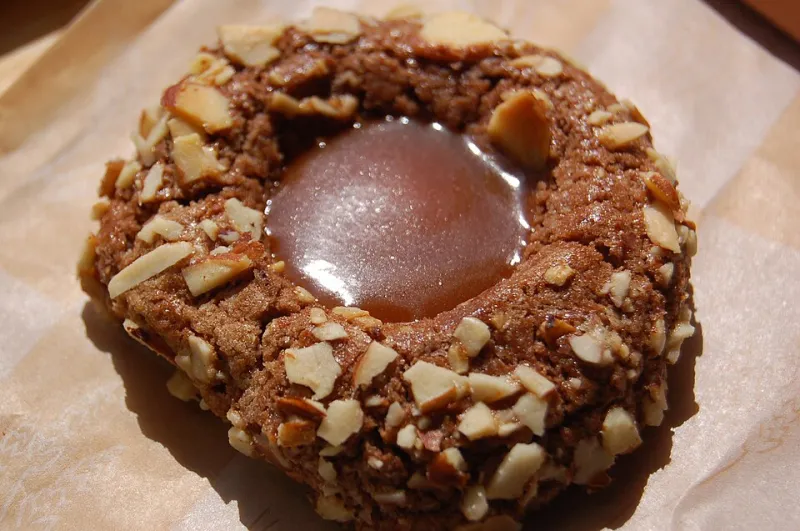
Photo: snowpea&bokchoi, CC BY 2.0, via Wikimedia Commons
We talk about wine pairings at dinner parties. We argue about which cheddar goes on a burger. But ask a room full of bakers which salt belongs on top of a caramel cookie and you'll mostly get a shrug — or a reflexive reach for whatever's in the round blue box.
That felt like a gap worth closing. Salt is the last ingredient we taste and, on a caramel-forward bake, arguably the one we notice most. So I ran an experiment in my own kitchen: one dough, one bake, seven salts, and a very patient group of taste-testers (my family, plus a neighbor who will never say no to cookies).
The Rules of the Test
To keep things honest, I made a single batch of chewy caramel cookies — brown butter, dark brown sugar, a splash of vanilla — and portioned the dough into seven identical rows. Each cookie got its salt sprinkled on top right before baking, roughly the same pinch by weight (about 1/8 teaspoon per cookie). Same oven, same sheet pan, same cooling rack.
The contenders:
- Maldon flaky sea salt — the pyramid-shaped darling of pastry Instagram
- Hawaiian black lava salt — dramatic, charcoal-colored, slightly mineral
- Smoked sea salt — cold-smoked over hardwood
- Celtic grey sea salt — damp, briny, hand-harvested
- Diamond Crystal kosher — the flaky, feather-light baker's workhorse
- Standard iodized table salt — the one everybody owns
- Sel gris — coarse, moist French grey salt
Tasting happened two hours after baking, at room temperature, with water in between. Scientific? Not exactly. Consistent? Absolutely.
The Tasting Notes
Maldon: The crowd favorite, and not a surprise. Those thin pyramids shatter on the tongue, delivering little bursts of salinity against the toffee notes. It reads as crunch first, salt second, which is exactly what you want on a soft cookie.
Smoked: This one split the room. On caramel, the smoke reads like a campfire bonbon — one tester said it tasted like "a s'more's sophisticated cousin." If your caramel leans dark and burnt-sugar bitter, this is a knockout pairing. On a lighter cookie, it would bully everything.
Hawaiian black lava: Visually stunning, flavor-wise subtle. The activated charcoal does the talking here; the salt itself is mild and slightly mineral. Best pick of the test for anyone baking for a crowd that eats with its eyes first.
Celtic grey: The moisture in this salt is its downfall on baked goods — the crystals never fully dried, leaving faint damp speckles and a briny, almost oceanic finish. Delicious on a tomato, odd on a cookie.
Diamond Crystal kosher: The sleeper hit. Because the crystals are so light and hollow, they dissolve quickly and season evenly. No crunch, no drama — just clean, balanced saltiness that lets the caramel sing. If Maldon is the soloist, Diamond Crystal is the orchestra.
Table salt: Fine, sharp, a little metallic thanks to the iodine. It distributes so finely that it nearly vanishes into the dough, and the iodine taste was noticeable to two of five tasters. It works. It never excels.
Sel gris: Big, coarse, crunchy, and proud of it. These crystals held their shape and delivered a proper snap — more assertive than Maldon, with a deeper, wetter minerality. A great match if you want the salt to be a stated ingredient, not a whisper.
The Pairing Chart
Think of this like a sommelier's cheat sheet:
| Your bake | Reach for | Why |
|---|---|---|
| Caramel, toffee, butterscotch | Maldon | Crunch contrast against chewy sweetness |
| Chocolate-heavy cookies | Smoked salt | Smoke amplifies roasted, bitter notes |
| Delicate shortbread or sugar cookies | Diamond Crystal | Even seasoning, zero texture interference |
| Anything going on a dessert table | Black lava salt | The visual drama sells itself |
| Rustic galettes, savory-sweet tarts | Sel gris | Bold crystals that stand up to fat and fruit |
| Everything, honestly | Kosher, any brand | The reliable default that never embarrasses you |
Why This Matters More Than You'd Think
Here's the baking-science kicker: on a caramel-based bake, salt isn't just seasoning — it's a flavor modulator. Salt suppresses bitterness and amplifies the Maillard-rich, toasty compounds that make browned sugar taste like browned sugar. The form of the salt changes the timing of that experience. A fine salt hits mid-chew and blends in; a flaky crystal hits first, on the tip of the tongue, before the sweetness arrives.
That timing is the pairing. Choosing salt for a bake is really choosing when and how loudly you want the salt to speak.
A Few Practical Takeaways
- Match texture to texture. Soft, chewy bakes love crunchy salts. Crisp bakes want salts that melt in.
- Salt after baking when in doubt. Sprinkling post-oven keeps delicate flakes intact and prevents dissolving into the dough.
- Skip table salt for finishing. Keep it for doughs and batters, where it dissolves anyway.
- Buy small. Finishing salts lose their magic when they absorb moisture. Little tins, used within a few months, taste better.
The round blue box earned its place in American kitchens, and it's not going anywhere. But the next time you pull a batch of caramel cookies from the oven, pause before you pinch. You've already paired the butter, the sugar, the vanilla. Give the salt the same courtesy — it's the last note of the song, and it's the one everybody hums on the way out the door.